[ad_1]
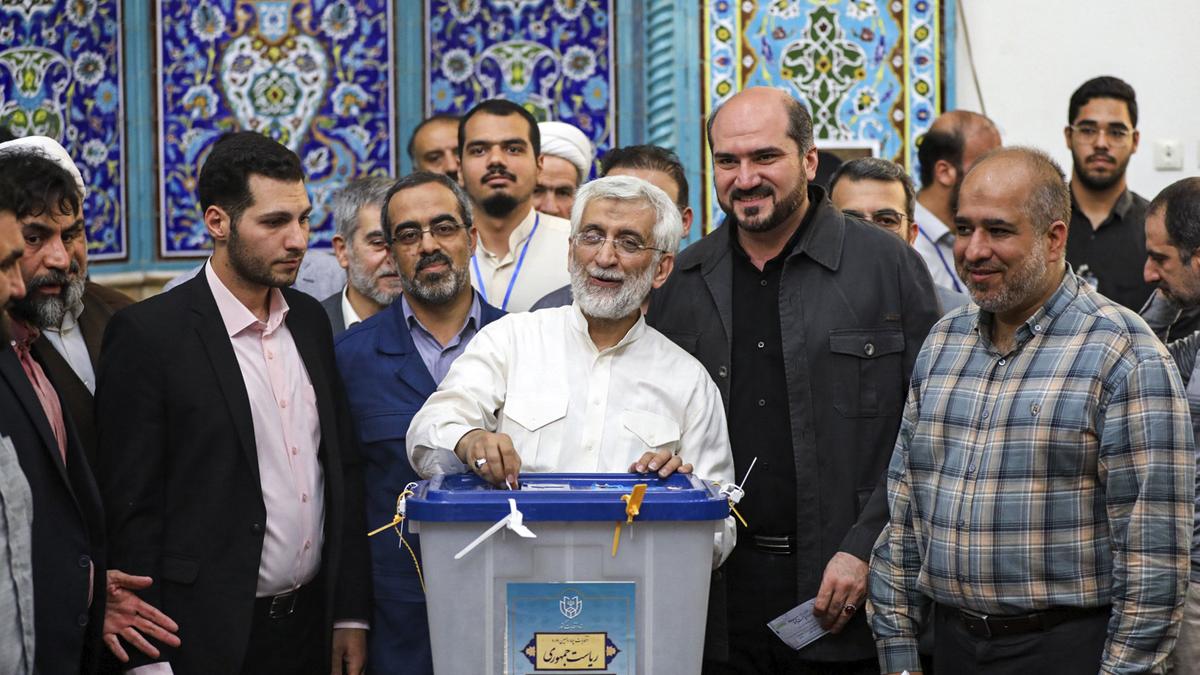
Hard-line former Iranian senior nuclear negotiator and candidate for the presidential election Saeed Jalili casts his ballot in a polling station, in Tehran, Iran, on June 28, 2024. Iranians are voting in a snap election to replace the late hard-line President Ebrahim Raisi.
| Photo Credit: AP
Seesawing results released early Saturday in Iran’s presidential election put the race between little-known reformist Masoud Pezeshkian and hard-liner Saeed Jalili, with the lead trading between the two men while a runoff vote appeared likely.
Iranian state television reported the results which did not initially put either man in a position to win Friday’s election outright, potentially setting the stage for a second round of voting to replace the late hard-line President Ebrahim Raisi who died in a helicopter crash last month.
So far, no turnout figures have been offered— a crucial component of whether Iran’s electorate backs its Shiite theocracy after years of economic turmoil and mass protests.
Voters faced a choice between the three hard-line candidates and Mr. Pezeshkian, a heart surgeon.
After counting over 19 million votes, Mr. Pezeshkian had 8.3 million while Mr. Jalili held 7.18 million. Another candidate, hard-line parliament speaker Mohammad Bagher Qalibaf, had some 2.67 million votes while Shiite cleric Mostafa Pourmohammadi had over 158,000 votes.
Iranian law requires that a winner gets more than 50% of all votes cast. If not, the race’s top two candidates will advance to a runoff a week later. There’s been only one runoff presidential election in Iran’s history: in 2005, when hard-liner Mahmoud Ahmadinejad bested former President Akbar Hashemi Rafsanjani.
There had been calls for a boycott, including from imprisoned Nobel Peace Prize laureate Narges Mohammadi. Mir Hossein Mousavi, one of the leaders of the 2009 Green Movement protests who remains in house arrest, also has refused to vote with his wife, his daughter said.

There’s also been criticism that Mr. Pezeshkian represents just another government-approved candidate. One woman in a documentary on Mr. Pezeshkian aired by state TV said her generation was “moving toward the same level” of animosity with the government that Mr. Pezeshkian’s generation had in the 1979 revolution.
The 63-year-old Raisi died in the May 19 helicopter crash that also killed the country’s foreign minister and others. He was seen as a protégé of Iran’s Supreme Leader Ayatollah Ali Khamenei and a potential successor. Still, many knew him for his involvement in the mass executions that Iran conducted in 1988, and for his role in the bloody crackdowns on dissent that followed protests over the death of Amini, a young woman detained by police over allegedly improperly wearing the mandatory headscarf, or hijab.
The voting came as wider tensions have gripped the Middle East over the Israel-Hamas war in the Gaza Strip.
In April, Iran launched its first-ever direct attack on Israel over the war in Gaza, while militia groups that Tehran arms in the region — such as the Lebanese Hezbollah and Yemen’s Houthi rebels — are engaged in the fighting and have escalated their attacks.
Meanwhile, Iran continues to enrich uranium at near weapons-grade levels and maintains a stockpile large enough to build — should it choose to do so — several nuclear weapons.
Despite the recent unrest, there was only one reported attack around the election. Gunmen opened fire on a van transporting ballot boxes in the restive southeastern province of Sistan and Baluchestan, killing two police officers and wounding others, the state-run IRNA news agency reported. The province regularly sees violence between security forces and the militant group Jaish al-Adl, as well as drug traffickers.
[ad_2]
Source link